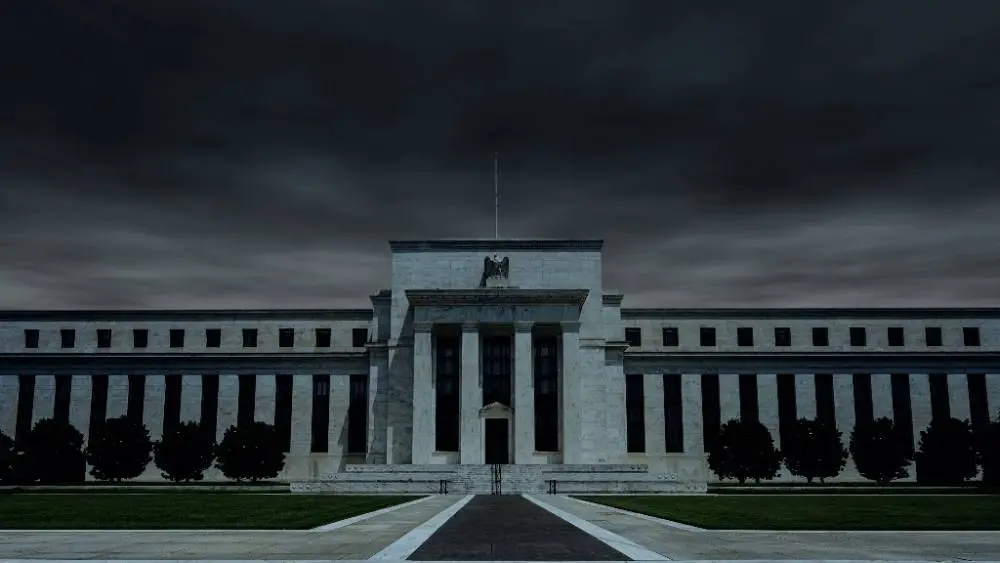
The Fed's pause buys emerging markets weeks, not relief
The Federal Reserve held rates on 28 October 2026 but signalled more tightening, and the narrowing rate gap is already squeezing India, Mexico and Indonesia.
In 30 seconds
- The Fed held its target range at 3.75% to 4% on 28 October 2026, but two officials voted for a hike and most policymakers expect another one this year.
- The gap between US rates and those in India, Mexico and Indonesia has narrowed, so their currencies have weakened and their central banks have tightened or intervened.
- The pause gives these countries until the 9 December decision. It does not remove the pressure, and a December hike would narrow the gaps again.
When the US Federal Reserve chooses not to move, the rest of the world often treats it as good news. The decision on 28 October 2026 is harder to read that way. The Fed held its policy rate, but it left little doubt that it may raise rates again. Several emerging-market central banks have already spent October paying for that expected rise.
The decision
The Federal Open Market Committee, the Fed’s rate-setting body, kept the target range for the federal funds rate at 3.75% to 4% [1]. The vote was 10 to 2. Governor Lisa Cook and Cleveland Fed President Beth Hammack voted against it because they wanted a quarter-point increase straight away [1].
The statement described growth as strong, an upgrade from solid six weeks earlier, and said again that inflation is still elevated [1][2]. It also dropped the September line explaining why the Fed had raised rates. In its place came a looser phrase saying that “the accumulation of more information will help”, which committed the Fed to nothing [1][11].
The real signal came from the Fed’s own forecasts. In September, when the committee raised rates by a quarter point on a 12-0 vote, 16 of its 18 policymakers projected at least one more increase before the end of 2026 [2][3]. Their median forecast put the policy rate at 4.1% at the end of both 2026 and 2027, and put inflation, measured by the personal consumption expenditures index, at 3.7% this year [3]. The next decision is due on 9 December [4]. Diane Swonk, chief economist at KPMG US, summed up the market’s reading: “Brace for a hawkish lean” [14].
A pause that points to another hike tightens conditions abroad almost as much as the hike itself.
Who it hits first
The first effect works through interest-rate gaps. Investors who borrow in dollars to buy higher-yielding assets elsewhere, a strategy known as the carry trade, need a wide enough gap to cover the risk that the other currency falls. Each Fed increase narrows that gap.
India. The Reserve Bank of India raised its repo rate by 25 basis points to 5.50% on 7 October 2026, its first increase in about four years. The vote was unanimous [5][8]. The bank reported net foreign portfolio outflows of $10.3 billion between April and 5 October. It also noted that the price of the Indian crude oil basket averaged $116.1 a barrel in September, up from $82.0 in July [5]. By Reuters’ count, foreign investors had taken a record $30 billion out of Indian equities by 8 October, and India’s 10-year bond premium over US Treasuries had narrowed to its smallest since 2004 [8]. Sajjid Chinoy, chief India economist at J.P. Morgan, said the rupee could end up as the “shock absorber” [13]. On 29 October, the day after the Fed decision, the rupee closed at 95.26 to the dollar after likely central-bank intervention [9].
Mexico. On 22 October the peso hit its weakest level in more than a year. It had lost 9.7% against the dollar since 4 September, and Mexico News Daily traced much of that fall to the narrowing gap between the Fed’s rate and the Bank of Mexico’s 6.5% [10]. The Bank of Mexico’s own reference rate moved from 18.6673 pesos per dollar on 28 October to 18.8148 the next day [7]. On those figures, the gap between the two policy rates is now 2.5 percentage points.
Indonesia. At its meeting on 20-21 October, Bank Indonesia held its main rate at 5.75% but raised its deposit facility rate to 5.00% [6]. It also offered bigger discounts on currency-hedging contracts to foreign investors: 40% off the premium on six-month contracts, up from 25%, and 45% off on 12-month contracts, up from 30%. The bank listed a tightening of US monetary policy among the reasons the rupiah fell to Rp17,985 per dollar on 20 October [6].
The second wave
The later effects reach households and companies. A weaker currency makes imported fuel and food dearer even when world prices hold steady. India’s central bank projects headline inflation of about 5.8% on average over the next three quarters [5]. Bank Indonesia’s choice shows the trade-off at work. It is defending the rupiah with higher short-term rates and hedging subsidies, and it is also cutting banks’ reserve requirements on 1 November and 1 December to keep lending growing [6]. Each country tightens on one side and loosens on the other.
Sat Dhura of Janus Henderson Investors said the direction of flows into India depends more on US yields, the dollar and oil than on any single RBI move. He added that the RBI may have to tighten more than domestic conditions alone justify [13]. That is the second wave: monetary policy set in Washington ends up shaping borrowing costs in Mumbai, Mexico City and Jakarta.
The other side
Not everyone expects December to bring another increase. Cem Karsan, founder of Kai Wealth, called the Fed’s earlier hawkish stance “kabuki theater”. He argued that the Fed’s next move will be towards easier policy, in order to calm long-term bond yields [15]. If he is right, emerging-market central banks that tightened early may have overpaid. On the same day, Jeffrey Gundlach of DoubleLine Capital argued the opposite: with the economy upgraded, the Fed should already be raising rates [15].
There is also a political argument. Narayana Kocherlakota, a former Minneapolis Fed president, said holding rates days before the 3 November midterm elections could be read as political influence. He also said a delay of one meeting is not a serious blow to the Fed’s independence [11].
For emerging markets, the most favourable reading is that the pause buys time. Bloomberg’s Menaka Doshi wrote that it gives the RBI some room, while noting that strong growth, expensive oil and rising food prices pull the other way [12]. Bank Indonesia says its incentives have drawn $9.9 billion of foreign inflows since June, and it reports reserves of $146.3 billion, enough to cover 5.3 months of imports [6]. Some central banks entered this period with buffers in place.
What to watch
- 5 November 2026: The Bank of Mexico announces a policy decision. Most analysts expect it to hold at 6.5% [10].
- About three weeks after the meeting: The Fed publishes the minutes of its 27-28 October meeting, which will show how many officials leaned towards a hike [11].
- 9 December 2026: The Fed’s next decision, with new projections [4]. A quarter-point rise would take the range to 4% to 4.25% and narrow every gap described above by the same amount.
- December 2026: The RBI’s next policy meeting. Soumya Kanti Ghosh of State Bank of India has said a 50-basis-point increase may be needed [8].
- 17 December 2026: The Bank of Mexico’s final decision of the year [10].
Sources
Publications
- Federal Reserve issues FOMC statement — Board of Governors of the Federal Reserve System, 28 October 2026
- Federal Reserve issues FOMC statement — Board of Governors of the Federal Reserve System, 16 September 2026
- FOMC projections materials, accessible version — Board of Governors of the Federal Reserve System, 16 September 2026
- Meeting calendars and information — Board of Governors of the Federal Reserve System, Accessed 3 November 2026
- Governor's Statement: October 7, 2026 — Reserve Bank of India, 7 October 2026
- BI-Rate Held at 5.75%: Strengthening Stability, Supporting Economic Growth — Bank Indonesia, 21 October 2026
- Foreign exchange market: FIX exchange rate — Banco de México, Accessed 3 November 2026
News
- India rate hike will not stem outflows, leaving central bank in a bind — Reuters, 8 October 2026
- Rupee ends flat after hitting two-week low, oil and RBI remain key — Reuters, 29 October 2026
- Peso hits one-year low as Fed-Banxico rate gap narrows — Mexico News Daily, 22 October 2026
- The Fed holds interest rates steady in a split vote before midterm elections — Quartz, 28 October 2026
- Fed Pause May Give India's Central Bank Breathing Room — Bloomberg (India Edition newsletter, Menaka Doshi), 29 October 2026
Analysts & newsmakers
- Sajjid Chinoy on the rupee as the economy's shock absorber; Sat Dhura on why outflows track US yields — Sajjid Chinoy, J.P. Morgan; Sat Dhura, Janus Henderson Investors; via Reuters, 8 October 2026
- Diane Swonk on why December is live and a hawkish lean is likely — Diane Swonk, chief economist, KPMG US, 28 October 2026
- Cem Karsan argues the Fed's next move will be easier policy; Jeffrey Gundlach argues it should be hiking — Cem Karsan, Kai Wealth; Jeffrey Gundlach, DoubleLine Capital; via CNBC, 28 October 2026
- Narayana Kocherlakota on the political reading of a pre-election hold — Narayana Kocherlakota, former Minneapolis Fed president; via Quartz, citing CNN, 28 October 2026
How this was made. Researched and drafted with AI assistance from primary documents and named reporting, then verified and approved by our editor, Fawad Rizvi. Every source is listed above. Spotted an error? Tell us.